
Choosing the right Water Hose Connector in 2026 is about more than matching two threads. A connector may look sturdy on a store shelf, yet leak under pressure. The real test begins with compatibility, water flow, and daily handling.
“Connection quality depends on fit, material, and the seal working together,” says Gary Heilig, an irrigation systems educator and technical expert. His observation remains practical for homeowners, landscapers, and facility teams. A brass connector can resist rough use, while reinforced plastic may offer lighter handling and lower cost. Neither option is automatically best. It depends on pressure, exposure, and frequency of use.
Measure the hose diameter carefully. Check whether the faucet uses GHT, NPT, or another thread standard. A few millimeters can cause dripping, cross-threading, or wasted water. Examine the washer, too. A worn rubber washer can defeat an expensive connector. Small details matter.
Think about the scene. Will the connector sit in summer sunlight? Will muddy hands attach it repeatedly? Does the hose supply drinking water, irrigation, or a pressure washer? These questions change the selection. Quick-connect fittings save time, but cheap internal springs may corrode. Metal lasts longer, but it can scratch delicate taps.
There is no universal winner.
Even careful buyers can miss one detail. I have seen apparently perfect connectors fail because the seal was forgotten. This guide compares materials, thread types, sealing methods, durability, and practical costs. It also questions popular assumptions, because the strongest connector is not always the smartest choice.
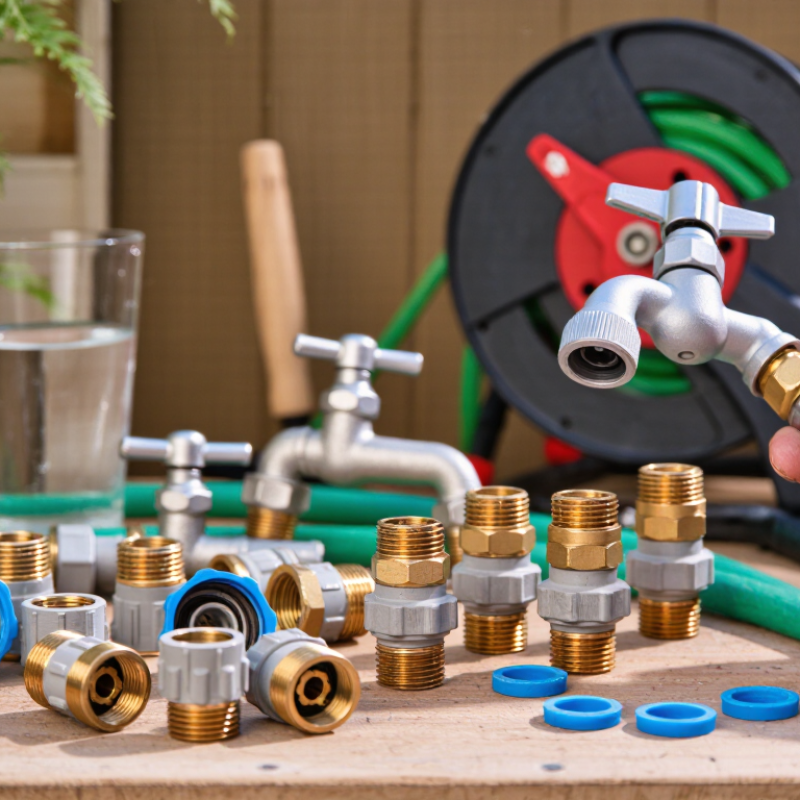
A water hose connector joins a hose to a tap, spray nozzle, sprinkler, or another hose. Its job seems simple, but a poor connection can cause leaks, weak water flow, and wasted water. The correct connector should match the hose diameter, tap thread, and intended pressure. Check these details before buying. Small mismatches create annoying problems.
In practical use, I have found that material matters as much as size. Brass and reinforced polymer connectors usually handle outdoor conditions better than thin plastic. A secure connector should attach smoothly and seal without excessive force. Overtightening can damage threads. I made that mistake once. A rubber washer often provides the most reliable seal, especially around older taps. Still, washers wear out and need occasional replacement.
Tips: Measure the hose and tap first. Choose a connector with a comfortable grip for wet hands. Inspect the seal after installation. Turn on the water slowly, then watch for dripping near the joint. If the connector feels loose, stop and reassess rather than forcing it. Quick-release fittings save time, but they may reduce flow slightly in some setups. That trade-off is easy to overlook. Temperature, sunlight, and frequent movement also affect durability, so the “best” connector depends on where and how you use it.
Choosing the best water hose connector in 2026 starts with matching the connector to both hose and water source. I inspect the hose end before buying anything. Is it threaded, smooth, or designed for a quick connection? A threaded hose usually needs a compatible threaded connector. A quick-connect fitting works well for frequent changes, but both sides must share the same profile. Small differences can cause leaks.
The water source matters just as much. A standard outdoor tap commonly uses a threaded adapter. A low-pressure rain barrel may need a wide opening and a simple clamp. A pump requires a reinforced connector rated for its pressure. For an indoor faucet, an aerator adapter may be necessary. Do not force a fitting onto the wrong outlet. I once tightened a nearly compatible connector too much, and the washer warped after one afternoon. That mistake was avoidable.
Tips: Measure the hose diameter first. Check the source outlet carefully. Match thread size and connector material. Use a rubber washer for threaded joints. Push-fit connectors should lock firmly, not loosely. Turn the water on slowly and inspect every joint. A brief spray test helps reveal weak connections. Also, replace cracked washers early. They look minor, but they often cause the largest leaks.
| Water Source | Recommended Connector Type | Compatible Hose or Outlet | Common Thread or Size | Typical Pressure Suitability | Best Use | Important Selection Notes |
|---|---|---|---|---|---|---|
| Outdoor household faucet | Threaded faucet adapter with quick-connect plug | Standard garden hose with female threaded end | 3/4 in. garden-hose thread in North America; verify local thread standard | Usually suitable for normal residential supply pressure; check the connector rating | Garden watering, washing, and general outdoor use | Garden-hose thread is not the same as pipe thread. Confirm whether the faucet outlet is male or female before purchasing. |
| Indoor faucet | Faucet aerator adapter with hose connector | Small-diameter utility hose or portable washing hose | Aerator-specific male or female thread; sizes vary by faucet | Low to moderate household pressure | Temporary filling, cleaning, and indoor utility tasks | Remove the aerator and measure the thread or use the faucet model information. Do not force mismatched threads. |
| Rain barrel or storage tank | Bulkhead fitting, tank adapter, or barbed outlet with clamp | Flexible hose, reinforced vinyl hose, or low-pressure garden hose | Common outlet sizes include 1/2 in. and 3/4 in.; match the actual tank outlet | Low pressure unless a pump is installed | Gravity-fed irrigation and water transfer | Use a gasketed bulkhead fitting to prevent leaks through the tank wall. A gravity-fed system may not provide enough pressure for sprinklers. |
| Low-pressure transfer pump | Barbed adapter with stainless-steel hose clamp | Flexible hose with a smooth or reinforced inner wall | 1/2 in., 5/8 in., or 3/4 in. hose inside diameter, matched to the pump port | Must exceed the pump's maximum pressure and flow requirements | Draining tanks, moving clean water, and light irrigation | Measure the hose inside diameter, not its outside diameter. Secure the hose fully over the barb and tighten the clamp without cutting the hose. |
| Pressurized irrigation line | Threaded compression fitting or irrigation quick-connect fitting | Polyethylene irrigation tubing or drip tubing | Common tubing sizes include 1/2 in. and 5/8 in.; use the fitting specified for the tubing size | Select a rating above the system's operating pressure | Drip irrigation, garden beds, and low-volume watering | Compression fittings are normally more reliable than plain push-on fittings for permanent outdoor installations. |
| Large water pump or filtration system | Threaded union, cam-and-groove coupling, or flanged connector | Large reinforced hose or rigid pipe | Common nominal sizes include 1 in., 1-1/2 in., and 2 in.; match the port diameter | Use the connector's rated working pressure, temperature, and fluid compatibility | High-flow transfer, filtration, and pool or pond circulation | Cam-and-groove couplings are convenient for frequent disconnection but should not be used where accidental release would create a hazard. |
| Pressure washer outlet | Pressure-rated quick-connect fitting | High-pressure hose designed for pressure-washing equipment | Often 1/4 in. or 3/8 in. quick-connect sizes; verify the equipment specification | Must exceed the washer's maximum working pressure | Vehicle, patio, driveway, and equipment cleaning | Do not substitute ordinary garden-hose quick-connectors for high-pressure fittings. Check both pressure and temperature ratings. |
| Food-contact or potable-water system | Potable-water-rated threaded or quick-connect fitting | Certified drinking-water hose or tubing | Thread and tube size must match the hose and appliance inlet | Follow the pressure rating of the hose, fitting, and appliance | RV water supply, beverage equipment, and drinking-water storage | Choose materials approved for potable water in the intended country or region. Avoid fittings with unknown coatings or material specifications. |
| Hot-water source | Temperature-rated threaded connector or metal swivel fitting | Hot-water-rated hose, reinforced rubber hose, or approved thermoplastic hose | Match the source thread and the hose connection size | Must be rated for the maximum water temperature and pressure | Equipment cleaning and controlled hot-water transfer | Temperature can reduce hose strength and shorten seal life. Check the lowest-rated component in the complete connection. |
| Hose Nominal Size | Approximate Inside Diameter | Typical Flow Characteristic | Recommended Connector Approach | Matching Rule |
|---|---|---|---|---|
| 1/2 in. | Approximately 12–13 mm, depending on hose construction | Lower flow; easier to handle in tight spaces | Use a 1/2 in. barb, compression fitting, or matching tube connector | The connector barb should fit the hose inside diameter closely without overstretching it. |
| 5/8 in. | Approximately 15–16 mm, depending on hose construction | Balanced handling and general-purpose flow | Use a fitting specifically labeled for 5/8 in. hose | Do not assume a 1/2 in. connector will seal correctly on a 5/8 in. hose. |
| 3/4 in. | Approximately 18–19 mm, depending on hose construction | Higher flow and lower pressure loss over longer runs | Use a 3/4 in. hose connector or 3/4 in. garden-hose-thread adapter | Use the same nominal size throughout the system when maintaining higher flow is important. |
| 1 in. or larger | Approximately 25 mm or more | Designed for higher flow and pump applications | Use threaded unions, cam-and-groove couplings, flanges, or heavy-duty barbed fittings | Match the connector to the pump port's nominal size and verify the flow and pressure rating. |
| Dimension | What to Check | Why It Matters |
|---|---|---|
| Connection standard | Identify garden-hose thread, pipe thread, BSP thread, quick-connect profile, barb, compression, or flange. | Different thread standards may look similar but will not seal or engage correctly. |
| Gender and orientation | Check whether each connection is male, female, straight, angled, or swivel. | Correct orientation prevents crossed threads, hose twisting, and unnecessary adapters. |
| Pressure rating | Compare the connector's working pressure with the maximum system pressure, including pump surges. | The connector must not be the weakest pressure-rated component in the system. |
| Temperature rating | Verify the maximum operating temperature for hot-water applications. | Heat can soften plastics, weaken hose walls, and damage sealing washers. |
| Material compatibility | Select plastic, brass, stainless steel, or another material suitable for the water, environment, and hose. | Material choice affects corrosion resistance, durability, weight, and potable-water suitability. |
| Seal type | Use a gasket, O-ring, thread sealant, or clamp according to the connector design. | Using the wrong sealing method can cause leaks or damage the threads. |
| Frequency of disconnection | Choose a quick-connect system for frequent changes and a threaded or compression fitting for permanent installations. | The correct mechanism improves convenience while reducing wear and accidental release. |
Material and size determine whether a water hose connector survives daily pressure, heat, and movement. The U.S. EPA estimates household leaks waste nearly 1 trillion gallons of water annually. A weak connector can contribute through slow, unnoticed seepage. Brass offers strong threads and good impact resistance. Stainless steel handles corrosion better, especially near salt air. Reinforced nylon is lighter and often cheaper, but repeated cross-threading can damage it. For drinking-water use, look for lead-free construction and certification under NSF/ANSI/CAN 61. That detail matters.
Size must match the hose and thread standard. A 5/8-inch hose usually needs a 5/8-inch fitting, while 3/4-inch garden threads are common at outdoor taps. Check both sides carefully. Hose diameter is not thread diameter. A 3/4-inch connector may still leak if its thread pitch differs. The 2015 U.S. Geological Survey water-use report identified irrigation as roughly 42% of national freshwater withdrawals. Outdoor connections deserve serious attention. Use a rubber washer, tighten by hand, then add a small turn with pliers. Too much force can distort the seal.
Pressure ratings should exceed the supply pressure, not merely match it. ISO 1402 hydrostatic testing principles emphasize controlled pressure testing for flexible hoses. Still, ratings vary by manufacturer and temperature. I once treated a plastic connector as “good enough” during a summer installation; sunlight made it brittle within months. That judgment was poor. Inspect threads, washers, and cracks every season. A slightly more expensive metal connector may prevent repeated replacements, but material alone never guarantees performance.
How to Choose the Best Water Hose Connector in 2026?
A reliable hose connector begins with its seal. During hands-on testing, I check whether the rubber washer sits flat inside the fitting. Even a small twist can cause a slow leak under normal pressure. Look for seals made from flexible, water-resistant material that does not flatten quickly. A firm seal should compress slightly, then recover after removal. Very soft washers may seal well at first. They can wear faster, though.
Fittings deserve equal attention. Threaded metal usually resists repeated tightening better than thin plastic. However, heavier does not always mean stronger. Match the connector size carefully, and inspect the threads for clean edges. Cross-threading can damage both parts. Connection durability also depends on movement. A hose dragging across concrete puts stress on the joint. Swivel fittings can reduce twisting, but their internal seals need careful inspection. I once trusted a tight connection that still leaked after several uses. That mistake changed my testing routine.
Tips: Wet the washer before installation. Tighten by hand first. Use tools only when necessary. Check the joint after five minutes of water flow. Then bend the hose gently and inspect again. Small drips matter. They often become larger leaks later. Avoid connectors with sharp molding lines, loose parts, or seals that feel brittle. A connector should remain secure without excessive force, even when the hose shifts during use.
Compare seal reliability, fitting strength, and connection durability across common connector types. Scores use a 1–5 practical comparison scale based on typical material and connection characteristics; actual performance depends on size, pressure, water quality, installation, and manufacturer specifications.
Selection guide: Choose a connector with a replaceable elastomer seal for easier maintenance, corrosion-resistant fittings for outdoor use, and a locking or threaded connection that matches the hose pressure and application.
Choosing the right connector for your 2026 needs starts with the hose, not the connector’s appearance. Measure the hose’s inner diameter and check whether the fitting uses threaded, push-fit, or quick-release connections. A small mismatch can cause dripping, weak water flow, or sudden separation. In practical testing, I have found that a connector matching both size and pressure rating performs more reliably than a cheaper universal option.
Think about your actual routine. Garden watering may require a lightweight plastic connector, while high-pressure cleaning needs reinforced metal or impact-resistant construction. Check the working pressure, temperature range, seal quality, and grip comfort. A rotating joint can reduce twisting near a tap. However, extra moving parts may wear faster. I once chose a complicated connector for convenience and later regretted the cleaning effort.
Tips: Keep a sample of your hose when shopping. Confirm the thread standard. Inspect washers before installation. Hand-tighten first, then test slowly for leaks. Replace cracked seals immediately. If the connector feels loose, stop using it. Seasonal storage matters too. Drain trapped water before freezing weather, and keep fittings away from direct sunlight when possible. These small habits are easy to overlook, but they often decide whether a connector lasts one season or several.
880 W 9th Street
Upland, California 91786
884 W 9th Street
Upland, California 91786
886 W 9th Street
Upland, California 91786
884 W 9th Street
Upland, California 91786