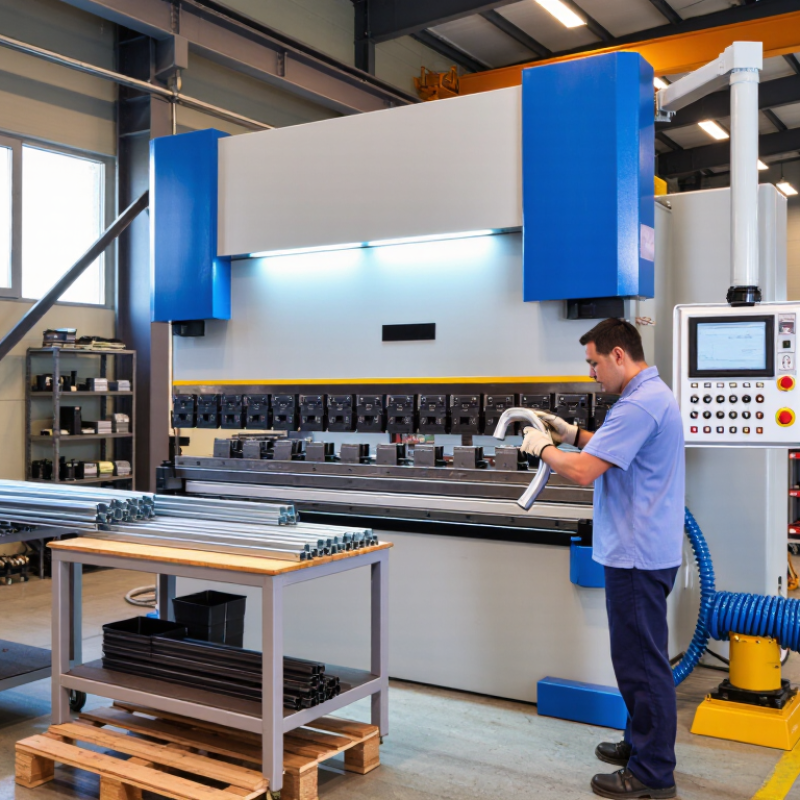
| Safety | Point-of-operation guarding | Fixed or interlocked guards should prevent access to the punch, die, linkage, and other crushing or shearing points during operation. | Prevents hands, clothing, and tools from entering hazardous areas while the machine is cycling. | Inspect the machine during a live demonstration. Confirm that guards cannot be easily bypassed and that opening an interlocked guard stops the hazardous movement. | Critical |
| Safety | Emergency-stop system | Use clearly marked, easily accessible emergency-stop devices that remove or safely control hazardous motion and require a deliberate reset. | Provides a rapid response option when an unexpected event occurs. | Press the emergency stop during a demonstration and verify that motion stops safely. Confirm that resetting it does not automatically restart the machine. | Critical |
| Safety | Two-hand control or presence-sensing protection | For operations where the operator’s hands could enter the danger zone, select an appropriate two-hand control or a validated presence-sensing device. | Helps keep the operator’s hands away from the closing area during the hazardous portion of the cycle. | Ask for the safety circuit assessment and functional test records. Check that controls require intentional operation and cannot be defeated by simple tying or blocking. | Critical |
| Safety | Safety-related control performance | Safety functions should be designed and validated according to the required risk level, commonly using ISO 13849-1 or an equivalent machine-safety method. | A safety component is not sufficient by itself; the complete control circuit must reliably perform its safety function. | Request the risk assessment, safety-circuit architecture, validation report, and applicable performance-level information. | Critical |
| Safety | Pneumatic energy isolation | Provide a lockable main air-isolation valve, pressure-release capability, and a means of preventing unexpected movement after shutdown. | Stored compressed air can move cylinders or tooling even after the electrical supply is switched off. | Close and lock the air-isolation valve, bleed residual pressure, and confirm that the actuator and tooling remain stationary. | Critical |
| Safety | Lockout/tagout compatibility | Electrical and pneumatic isolation points should accept locks and be clearly identified for servicing. | Supports safe cleaning, adjustment, fault finding, and maintenance procedures. | Check the isolation points physically and compare them with the machine’s lockout/tagout instructions. In the United States, review compatibility with OSHA 29 CFR 1910.147 where applicable. | Critical |
| Safety | Noise and exhaust management | Use a pneumatic circuit with suitable silencers or controlled exhaust, while maintaining the required flow and response time. | Reduces operator exposure to exhaust noise and prevents uncontrolled air discharge near people or workpieces. | Measure workplace noise under normal operating conditions and check whether exhaust ports can be fitted with suitable silencers without causing back pressure. | Important |
| Safety | Risk-assessment documentation | Supplier documentation should identify hazards, residual risks, protective measures, operating limits, and required user training. | Enables the purchaser to integrate the machine safely into the production line and workplace. | Request the operating manual, declaration of conformity or applicable compliance documents, risk assessment summary, and safety training requirements. | Critical |
| Maintenance | Air-quality requirements | The machine should specify required air pressure, flow, filtration, dew point, and oiling requirements. Use a properly sized filter-regulator and dryer where required. | Water, particles, and unsuitable oil can damage valves, seals, cylinders, and proportional components. | Compare the machine’s air-quality specification with the plant compressor and treatment system. Confirm pressure and flow at the machine inlet while cycling. | Critical |
| Maintenance | Pressure regulation and monitoring | Include a visible regulator, pressure gauge, and, where practical, a pressure switch or sensor that detects insufficient supply pressure. | Stable pressure improves repeatability and helps prevent incomplete or unexpectedly slow bending cycles. | Observe the pressure during repeated cycles and check whether the controller generates an alarm or safe stop when pressure falls below the defined limit. | Critical |
| Maintenance | Condensate drainage | Provide accessible manual or automatic drains on the filter and air-treatment equipment. | Regular removal of condensate protects pneumatic components and reduces corrosion and valve malfunction. | Check drain access, drainage frequency, and whether the maintenance manual explains safe depressurization before servicing. | Important |
| Maintenance | Lubrication and cylinder serviceability | Moving pivots, guides, bearings, and pneumatic actuators should have defined lubrication or inspection procedures and accessible service points. | Correct lubrication reduces friction, wear, stick-slip motion, and loss of positioning accuracy. | Review the maintenance schedule and inspect whether service points are reachable without removing guards or entering a hazardous zone. | Critical |
| Maintenance | Hose and fitting protection | Use hoses and fittings rated for the maximum pressure, protected from abrasion, sharp edges, heat, and excessive bending. | A damaged pneumatic hose can whip, leak, or cause sudden actuator movement. | Inspect routing, bend radius, fittings, clamps, and protective sleeves. Confirm that replacement parts have matching pressure and temperature ratings. | Critical |
| Maintenance | Preventive-maintenance schedule | The supplier should provide task-based intervals for daily, weekly, monthly, and annual inspections; exact intervals must reflect duty cycle and environment. | Maintenance needs vary with cycle frequency, dust, humidity, load, and air quality, so a generic interval is not sufficient. | Request a maintenance checklist covering fasteners, tooling, guards, air leaks, sensors, lubrication, filters, and safety devices. | Critical |
| Maintenance | Leak detection and energy efficiency | Choose a design with accessible pneumatic connections, isolation valves, and diagnostic capability for locating leaks. | Compressed-air leaks increase energy consumption and can reduce available force and cycle consistency. | Perform a leak check at operating pressure and ask whether the controller can display pressure trends, cycle counts, or fault history. | Important |
| Control | Operating modes and setup control | Provide clearly defined setup, manual, single-cycle, and automatic modes with restricted access to hazardous functions during adjustment. | Separating setup and production modes reduces unintended cycling during tooling changes and inspection. | Test every operating mode and confirm that mode selection, access levels, and safety devices behave as described in the manual. | Critical |
| Control | Cycle and force control | Allow controlled adjustment of stroke, dwell time, speed, and regulated pressure within the machine’s rated limits. | Controlled parameters improve bend consistency and help prevent excessive force, material damage, or tool overload. | Run representative workpieces at several approved settings and verify that parameter limits prevent unsafe or mechanically damaging values. | Critical |
| Control | Repeatability and position feedback | For precision work, select position sensing or a verified mechanical stop with repeatability data relevant to the required bend tolerance. | Open-loop pneumatic motion can vary with pressure, load, friction, and temperature. | Request repeatability test results using the intended material and tooling. Measure multiple consecutive cycles rather than relying on a single sample. | Critical |
| Control | Fault detection and diagnostics | The controller should identify low pressure, guard-open status, sensor failure, emergency-stop activation, and incomplete-cycle conditions. | Clear diagnostics shorten troubleshooting time and reduce unsafe fault-reset practices. | Simulate permitted faults and confirm that the machine stops or inhibits cycling, displays a clear message, and records the event when applicable. | Critical |
| Control | Reset and restart behavior | After a guard opening, emergency stop, power interruption, or pressure loss, the machine should require a deliberate reset and new start command. | Prevents unexpected automatic restart when personnel may still be near the tooling. | Interrupt each condition during a cycle and verify that the machine does not resume motion without the required reset and start sequence. | Critical |
| Control | Human-machine interface | Use clearly labeled controls, readable status indicators, understandable alarms, and access protection for safety-critical parameters. | Operators make fewer errors when machine states and required actions are immediately clear. | Ask an operator unfamiliar with the machine to complete basic setup and fault recovery using only the manual and on-screen instructions. | Important |
| Control | Data logging and connectivity | Where traceability is required, select cycle counters, alarm history, parameter backups, and suitable industrial communication interfaces. | Production and maintenance data can support quality investigations, preventive maintenance, and downtime analysis. | Confirm supported protocols, data fields, user permissions, backup methods, and whether connectivity affects the safety control system. | Important |
| Selection Fit | Rated capacity and tooling compatibility | The rated force, stroke, opening, throat depth, tooling dimensions, and duty cycle should exceed the intended workpiece requirements with a documented safety margin. | Operating near or beyond the rating accelerates wear and can create structural, tooling, or pneumatic hazards. | Submit representative material, thickness, bend length, tooling, and production-cycle information for a written capacity confirmation. | Critical |
| Selection Fit | Training and service support | Choose a supplier that provides operator and maintenance training, spare-parts lists, manuals, electrical and pneumatic schematics, and defined response procedures. | Safe performance depends on correct setup, inspection, fault recovery, and service practices throughout the machine’s life. | Review the training syllabus, spare-parts availability, service response terms, and documentation language before signing the purchase order. | Critical |